
NICU Mothers’ Journey Through Separation and Hope
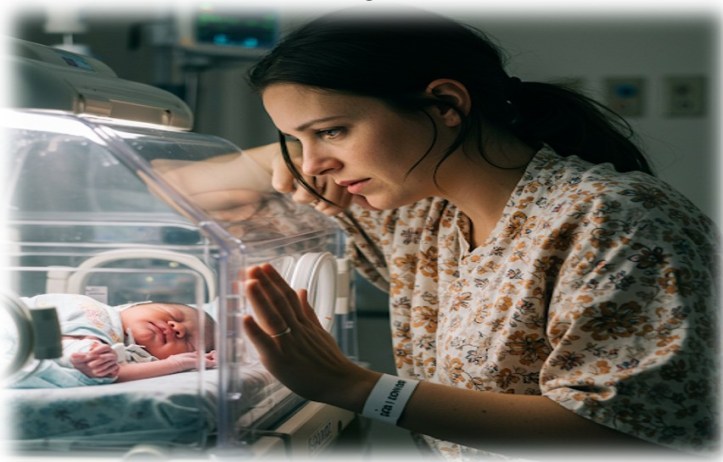
Before I even had a chance to touch or see my son, a nurse rushed him to the neonatal intensive care unit (NICU), while my gynecologist was still stitching me up at the end of the C-section surgery. Several hours passed before I was finally able to move. I sat in a wheelchair that my husband pushed, for a few minutes, until we arrived at the NICU, at St. Justine Hospital.
The reception area was family-friendly and inviting, with a large kangaroo doll wearing a Christmas hat. We smiled and took a photo of it, thinking it was a lovely change from the usual sight of teddy bears. Then, a nurse came and guided us to my son’s room, where I thought I’d be able to hold my baby freely, just like any other mother, but I was disappointed.
My baby was immersed in a knot of wires, tubes, and sensors. Around his bed were a multitude of devices I’d only ever seen in movies, and on his tiny nose was a large mask that pumped oxygen, obscuring the face I had waited so long to see.
I burst into tears, and the nurse began to calm me down, saying that we should touch our son and be close to support his cognitive and physical development. She helped me hold him without moving the breathing mask or the oxygen sensor, as any wrong movement could put his life at risk.
After that, she told us that it would be best to give our baby a skin-to-skin session, where we had to expose our chests, and then she would place the baby, naked except for his diaper, on my chest or his father’s, so that we both feel the skin of each other. This would give him the love he needed to develop better. “He will feel connected to you, just like a baby kangaroo!” Only then did we understand why there was a huge kangaroo doll at the reception desk.
This aroused my curiosity, so I dedicated much of the little free time, in my busy new-mom schedule, to read about it. I found a study by Arya et al. (2021), confirming the benefits of continuous kangaroo mother care for premature infants
as it increases their survival by 25%.
According to the World Health Organization, around 15 million babies are born prematurely each year (World Health Organization: WHO, 2022), meaning that millions of mothers experience the pain of NICU separation. The first skin-to-skin session gave me instant relief, and as soon as my baby was placed on my bare chest, my maternal instinct told me he felt better, too.
Still, it was impossible to ‘live’ with my son in the NICU day and night. I had to leave him there, leaving my heart behind, for long stretches every day. I ended up torturing myself with guilt and shame even though I knew that what forces my too-
early C-section was preeclampsia, a serious condition that causes sever high blood pressure and reduces the oxygen and nutrients that reach the baby. It was also the reason why my baby weighed only 800 grams at birth (Roberts & Escudero, 2012).
And during my lunch breaks in the NICU’s kitchen, I met other mothers who were also blaming themselves for their babies’ prematurity. Again, this led me to more reading. I found a study on 248 parents of preterm babies, where 46% of them experienced regret about their baby’s NICU stays. Of those, 35% felt guilt, 20% regretted not knowing how to care for their babies, and mothers reported more guilt than fathers (Thivierge et al., 2022).
What makes the separation feelings worse is the myth of the ‘relaxing motherhood’ while having your baby in the NICU. Almost all those who knew about my story, including my family members, thought I was lucky to have two-month break to
recover after my C-section. Only those who have been through the same would understand the agony of being a way of my sick and tiny baby.
At first, I thought it was just me: a mother in her forties, feeling too old to care for a newborn. But after talking to my NICU neighbors, I became more curious about the issue. I wasn’t surprised to find many stories online of NICU mothers venting
to one another about the same struggles I’ve been facing. That is how I became a friend with Najwa, another NICU mother whom I had first met online, in a Facebook group for maternal issues. She told me before that her baby had a surgery for an inguinal hernia, occurring in 13% of preterm babies, where part of the intestine pushes through the abdominal wall in infants (Sharma & Curry, 2015).
When I learned my son needed surgery too, I felt scared. I spent hours in the NICU, feeling like I was on the verge of collapse, so I called Najwa for comfort. “I feel you,” she said in a sad tone, “But you need to relax, or you won’t be able to take care of him.” Her words convinced me that my guilt feelings are the result of stress.
I felt helpless when I reached out to one of the hospital’s social workers and the spiritual therapist. They supported me and helped me to relaxed and focus on the positive: my son and I are safe, and we’ll be together soon. I hesitated to talk to them in the beginning fearing judgement, but I was wrong. It is important to share your struggles and seek help form everyone available when you feel overwhelmed. This bitter experience is dangerous.
A study showed that parents of premature babies have higher levels of post- traumatic stress, 40% experienced depression, and 50% showed anxiety symptoms (Treyvaud & Brown, 2022). Another study showed that having a preterm baby in the NICU leads to chronic anxiety and depression in mothers, which requires attention to mother’s well-being during and after the NICU stay (Klein & McDonald, 2024).
That is why I think NICUs should start focusing on the well-being of both the baby and the mother, at the same time. According to Wang et al. (2021), the disrupted bonding cripple mothers with shock, fear, and anxiety. Hence, support from family, faith, healthcare professionals is essential.
In a review of studies conducted between 1998 and 2008, the experiences of parents with babies in the NICU were examined, and the researchers found that those parents often display mood disorders and a sense of loss of control (Obeidat et al., 2009). That is why family-centered care should be supported in NICUs.
The impact of being separated from one’s baby is long-lasting on mothers. They might display overprotectiveness, which affect their overall quality of life and well-being. Also, they are not fully prepared for the challenges that might occur after discharging their babies, including meeting the baby unexpected needs and facing intrusive questions form others. That is why those mothers must have better post-NICU support (Granero-Molina et al., 2018).
I have experienced this firsthand. If it hadn’t for my husband’s continuous support, along with the care and guidance of my good friends and experienced professionals, I don’t know I would have managed. I was lucky, I have to say!
And as the days passed in the NICU, my bond with my baby grew stronger, day by day, and kangaroo session by kangaroo session. The peace I felt with him so close to my heart kept our love strong, helping ease my anxiety and making me more mindful of his joy. Now, as I watch my healthy, happy son, I reflect on my story. Although my NICU journey was filled with stress and fear, it was also a journey of love and hope.
My NICU memories are no longer painful. I enjoy talking about those days with my husband and family sometimes, and to remind myself of that special kangaroo bond, I bought a kangaroo doll, smaller than the one I saw in the hospital, but big
enough to rest on my son’s bed, keeping our memories fresh and close.
References
Arya, S., Naburi, H., Kawaza, K., Newton, S., Anyabolu, C. H., Bergman, N., Rao,
S. P. N., Mittal, P., Assenga, E., Gadama, L., Larsen-Reindorf, R., Kuti, O., Linnér,
A., Yoshida, S., Chopra, N., Ngarina, M., Msusa, A. T., Boakye-Yiadom, A., Kuti,
B. P., . . . Massawe, A. (2021). Immediate “Kangaroo Mother Care” and Survival
of Infants with Low Birth Weight. New England Journal of Medicine, 384(21),
2028–2038. https://doi.org/10.1056/nejmoa2026486
Granero-Molina, J., Medina, I. M. F., Fernández-Sola, C., Hernández-Padilla, J.
M., Del Mar Jiménez Lasserrotte, M., & Del Mar López Rodríguez, M. (2018).
Experiences of Mothers of Extremely Preterm Infants after Hospital Discharge.
Journal of Pediatric Nursing, 45, e2–e8.
https://doi.org/10.1016/j.pedn.2018.12.003
Klein, C. C., & McDonald, N. M. (2024). Parenting stress following a neonatal
Intensive care unit hospitalization: A Longitudinal study of Mothers and Fathers.
International Journal of Environmental Research and Public Health, 21(8), 970.
https://doi.org/10.3390/ijerph21080970
Obeidat, H. M., Bond, E. A., & Callister, L. C. (2009). The parental experience of
having an infant in the newborn intensive care unit. The Journal of Perinatal
Education, 18(3), 23–29. https://doi.org/10.1624/105812409×461199
Roberts, J. M., & Escudero, C. (2012). The placenta in preeclampsia. Pregnancy
Hypertension, 2(2), 72–83. https://doi.org/10.1016/j.preghy.2012.01.001
Sharma, S., & Curry, J. (2015, March 1). Inguinal hernia in premature infants.
https://pmc.ncbi.nlm.nih.gov/articles/PMC4268752/
Thivierge, E., Luu, T. M., Bourque, C. J., Duquette, L., Pearce, R., Jaworski, M.,
Barrington, K. J., Synnes, A., & Janvier, A. (2022). Guilt and regret experienced
by parents of children born extremely preterm. The Journal of Pediatrics, 257,
113268. https://doi.org/10.1016/j.jpeds.2022.10.042
Treyvaud, K., & Brown, S. J. (2022). Mental health of children and parents after
very preterm birth. World Psychiatry, 21(1), 148–149.
https://doi.org/10.1002/wps.20936
Wang, L., Ma, J., Meng, H., & Zhou, J. (2021). Mothers’ experiences of neonatal
intensive care: A systematic review and implications for clinical practice. World
Journal of Clinical Cases, 9(24), 7062–7072.
https://doi.org/10.12998/wjcc.v9.i24.7062
World Health Organization: WHO. (2022, November 15). WHO advises
immediate skin to skin care for survival of small and preterm babies. WHO.
https://www.who.int/news/item/15-11-2022-who-advises-immediate-skin-to-skin-
care-for-survival-of-small-and-preterm-babies

