
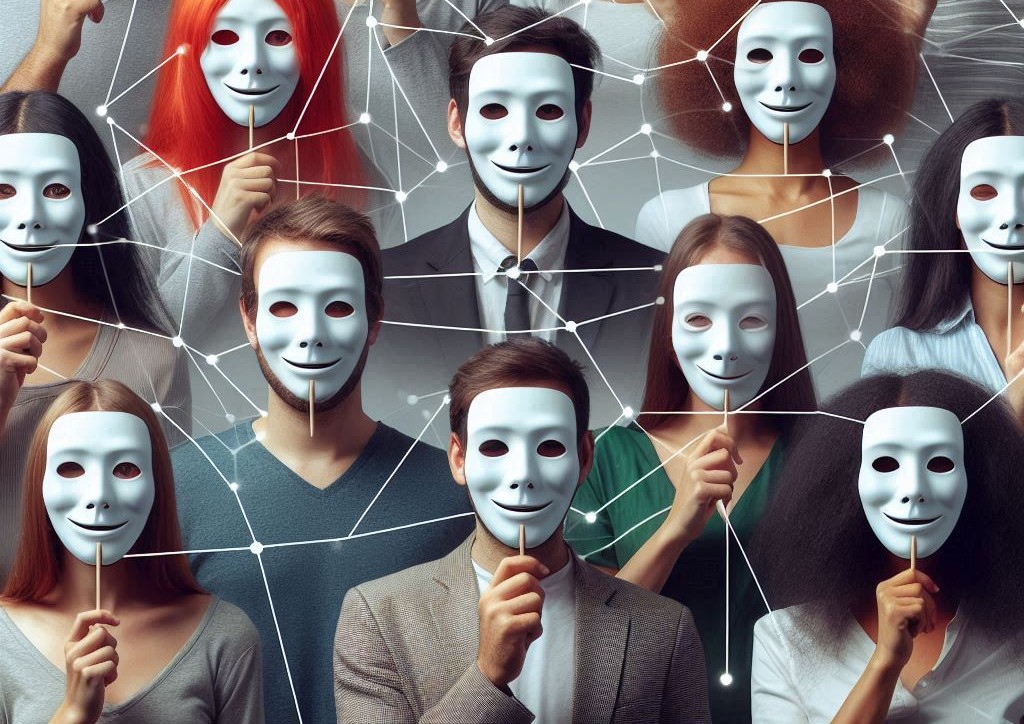
With millions of people using social media every day, the internet has undeniably woven itself into the fabric of our daily lives. It is where we connect with friends, share snapshots of our daily adventures, and lose ourselves in delightful streams of cat videos! One significant aspect of using the internet is the ability to interact with others while concealing our identities. This anonymity has both good and bad sides to it, which is why it sparks heated debates. Some advocate for its preservation, and others suggest it should be restricted [1].
Still, this phenomenon is indeed a big part of what makes the internet both a wonderful and a terrible place. Being unknown online makes it easy to use fake names, create unverified accounts, and use technology like VPNs that hide IP addresses. This can easily turn anyone into an internet ‘troll’ (a person who offends and harasses others online). With the power to stay anonymous, a mild-mannered person who, in the real world, would not hurt a fly, can suddenly start throwing verbal punches like a heavyweight boxer.
This observation is supported by a study showing that anonymity and the lack of eye contact make people behave more aggressively online [2]. Imagine trying to insult someone while staring into their eyes – not so easy, right? But take away that eye contact, and suddenly people feel bold enough to say the meanest things. Cyberbullying is a serious issue that thrives in the shadows of anonymity, which can increase hateful comments on social media, especially sexist ones [3], as if people put on their worst behaviour costume as soon as they know they will not get caught.
Another study has also found that anonymity can lead some people to engage in illegal activities online [4]. A normally shy person may become surprisingly confident when hidden behind a screen, as anonymity can alter our behaviour and grant some of us a superhero’s cape! But instead of fighting crime, some use it to hurt others. It is like giving a mischievous kid free reign in a candy store – you know it is going to end badly.
This is what Amanda Todd, a 15-year-old girl from British Columbia, suffered from. She was coerced to reveal herself on a web cam and then received hundreds of online threats from a 44-year-old man, called Aydin Coban. He demanded her to share web cam shows with him and used different platforms and different usernames to threaten her. He then used her images to blackmail her for more web cam shows [5].
Despite changing schools and cities, the harassment continued, and she was followed with relentless online abuse. In September 2012, she posted a video about her story, and in October the same year, Amanda Todd took her own life, unable to endure the pain any longer. Amanda’s heartbreaking video went viral, and her suicide story drew both local and international attention. This prompted the federal government to address online harassment by criminalizing the distribution of individuals’ images without their consent. As a result, Bill C-13 was introduced, which is also known as Protecting Canadians from Online Crime Act, and ten years later, Aydin Coban was arrested and sentenced to 13 years in prison [6].
Yet, it is essential to remember that anonymity is not just a tool for those with malicious intent; it provides numerous benefits to peaceful internet users as well. For instance, we all know how hiding our identities online protects our privacy, which results in strengthening our personal security and keeping us safe from the attacks of scammers and hackers.
Likewise, anonymity allows people to express their feelings and ideas more openly without fear of judgement. A meta-analysis study found that being anonymous online encourages people to share personal details and makes them more comfortable talking about themselves [7]. This can be really helpful particularly for those suffering from social anxiety, allowing them to connect with others and find a supportive community without compromising their privacy. Picture it as social media’s version of liquid courage, but instead of tequila shots, it is anonymity doing the talking!
Additionally, one more important advantage of anonymity online is how it empowers oppressed people and enhances human rights activities. For instance, knowing that sexual assault victims do not usually talk about what happened to them fearing stigma or criticism from members of their community, a group of women’s rights activists in Bahrain has created the Instagram account “Catcalls of Bahrain” to offer a safe space for victims who anonymously share their stories and demand stricter laws against sexual assailants [8]. By hiding their identities, vulnerable individuals and groups can enjoy the freedom of speech to argue against their oppressors, advocate for human rights, and support just causes. If anonymity online was not allowed, those involved in these activities will surely face discrimination and harassment, and in some regions of the world, persecution, torture, and even death penalty. This means that, in critical situations, online anonymity can save lives.
To conclude, this controversial phenomenon has triggered an intense discussion due to its potential risks and benefits. On one hand, online anonymity protects privacy, promotes open expression, and supports human rights. On the other hand, it may lead to cyberbullying and other dangerous activities. Therefore, we should strive for balanced solutions that maximize its gains while eliminating its harms. This, in my opinion, can be achieved by finding ways to hold people accountable while maintaining their privacy, making the online world a better place for everyone. So, next time you are online, hiding behind your screen, remember that with great anonymity comes great responsibility.
Enjoyed the read? Go on and buy me a chamomile 😋

References
1. Eklund, L., Von Essen, E., Jonsson, F., & Johansson, M. (2021). Beyond a dichotomous understanding of online anonymity: bridging the macro and micro level. Sociological Research Online, 27(2), 486–503. https://doi.org/10.1177/13607804211019760
2. Lapidot-Lefler, N., & Barak, A. (2012). Effects of anonymity, invisibility, and lack of eye-contact on toxic online disinhibition. Computers in Human Behavior, 28(2), 434-443. https://www.sciencedirect.com/science/article/pii/S0747563211002317
3. Fox, J., Cruz, C., & Lee, J. Y. (2015). Perpetuating online sexism offline: Anonymity, interactivity, and the effects of sexist hashtags on social media. Computers in Human Behavior, 52, 436-442. https://doi.org/10.1016/j.chb.2015.06.024
4. Aldridge, J. (2019). Does Online Anonymity Boost Illegal Market Trading? Media Culture and Society. https://doi.org/10.1177/0163443719842075
5. Grant, J. (2022, October 15). Aydin Coban sentenced to 13 years for sexual extortion of Amanda Todd. CBC. https://www.cbc.ca/news/canada/british-columbia/aydin-coban-sentencing-october-14-1.6616874
6. Amanda Todd Case. (n.d.). The Canadian Encyclopedia. https://www.thecanadianencyclopedia.ca/en/article/amanda-todd-case
7. Clark-Gordon, C. V., Bowman, N. D., Goodboy, A. K., & Wright, A. (2019). Anonymity and Online Self-Disclosure: A Meta-Analysis. Communication Reports, 32(2), 98–111. https://doi.org/10.1080/08934215.2019.1607516
8. Gendered violence online: Cybersecurity for whom? (n.d.). Middle East Institute. https://www.mei.edu/publications/gendered-violence-online-cybersecurity-whom
 Read Science Journal